Wednesday, September 23, 2015

Week 5 Storytelling: Palace of Fire

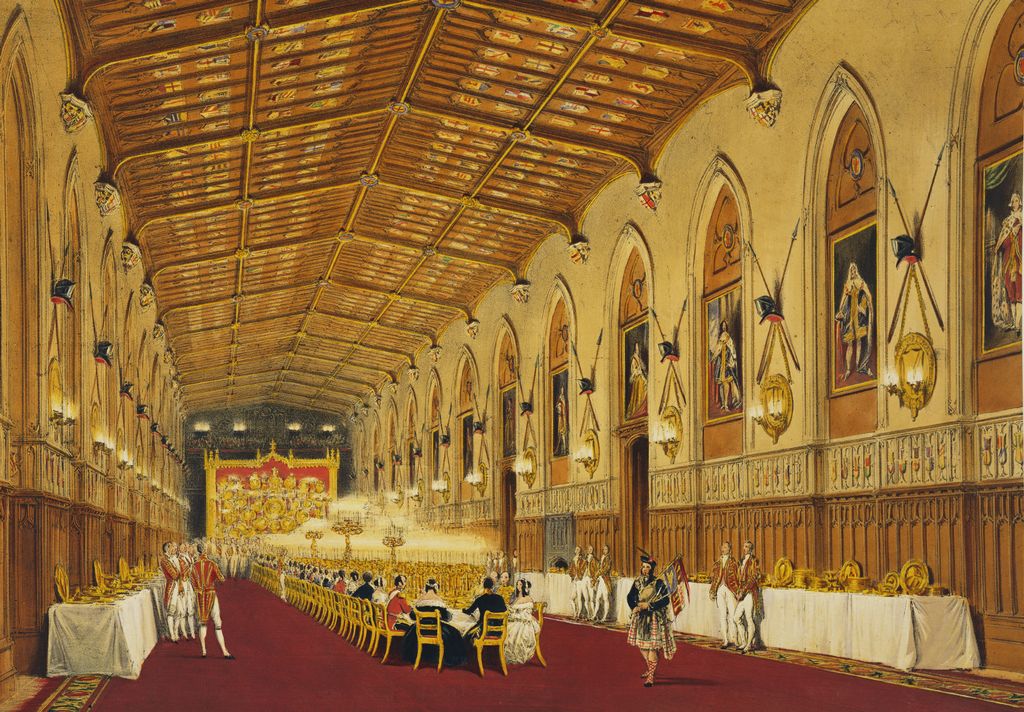
The Pandavas and their mother, Queen Kunti rode to the top of the hill, where an enormous palace stood, its magnificence matched nowhere else on Earth. It was a malevolent masterpiece of Prince Duryodhana, but the Pandavas did not yet realize the Prince's cruel intent.  They entered the Great Hall.  Above them was a vaulted wooden ceiling.  Emblems of all the great families lined the ceiling, and statues of fierce warriors watched over the vast space.  Despite their royalty and wealth, the Pandavas had never gazed upon any palace as grand.  They looked forward to spending the next few months in the place.

The Great Hall (in a strange gothic style)
Image from Wikipedia


Now Yudhishthira had received a warning from Prince Vidura about Duryodhana's treachery.  He soon realized that the entire palace was built with wood and soaked in oil.  His rage was immediately inflamed and he desired to leave the castle at once and kill Purochana, the guard Duryodhana had sent along with them.  Yudhishthira realized that Purochana had been sent to set the palace ablaze.  However, he realized that killing Purochana would seem unjustified and anger his people.  Instead, as he calmed down, he concocted a different plan to enact his revenge.  He counseled with his mother and the rest of his brothers, and they set to work at once.

The next day they announced their plans to hold a grand banquet to celebrate the completion of the palace.  As a reward for overseeing its completion, the Pandavas invited Purochana and all the other guards to attend this feast.  Yudhishthira went into the city hire additional kitchen staff and make the necessary arrangements.  Unbeknownst to Purochana, he also found a miner to help him complete a special project.  For the next fortnight, the Pandavas kept Purochana under a keen eye to make sure he did not set the palace on fire.

Finally, the day of the feast arrived.  The tables were decorated to their finest and there was enough food to feed an entire army.  Near the end of the meal, Yudhishthira accidentally knocked over a candle while raising his glass.  The table immediately burst into flame.  At the same time, all around the palace, servants set fire to the building and left with great haste.  The Great Hall stirred with commotion as the guards rushed to leave.  In their hurry, none of them realized that the royal family had disappeared.  The entire palace was engulfed in flames and the guards had no means of escape.  They all perished.

The next morning, the townspeople saw the heap of ashes and began to mourn the loss of the royalty.  At that time, the Pandavas arose from the underground shelter which the miner had built.  When the people saw the Pandavas arise from the ashes they shouted, "Masters of the Flames!"  Thus the Pandavas had their revenge and their glory was doubled throughout their kingdom.

Author's Note:  This story was particularly difficult to write.  I enjoyed the story about the "House of Fire" especially because of the tunnel.  However, building a tunnel seemed somewhat pointless since the Pandavas could have just walked out of the house.  I wanted to retell the story where the Pandavas are in the house when it catches fire so an underground passage is needed.

Bibliography:
"The House of Fire" by C.A, Kincaid, from The Indian Heroes (1921).  Web Source: PDE Mahabharata.

Tuesday, September 22, 2015

Reading Diary B: PDE Mahabharata

21. House of Fire - I don't understand why Prince Vidura has a miner dig a tunnel out of the house.  Although it is an interesting way for them to escape, it seems unnecessary.  They weren't prisoners, they could have just left when they realized that the house was soaked in oil.  I also expected Vidura to be punished for the deaths of the innocent beggars, but instead, they just provided a means of escape for the Pandavas.

Vidura's Tunnel
Image from Wikipedia

23. Bhima and Hidimbi - That was fast.  Bhima barely knows Hidimbi when he decides to take her as his bride.  Bhima is very good at breaking backs.  He also breaks Jarasandha's back later in the story.

27. Wife of the Five Pandavas - It is strange to me that Draupadi is accidentally married to five men.  People in the Mahabharata take their words very seriously even when the outcome does not make sense.  For instance, when Arjuna walks in on Draupadi and Yudhishthira he stays true to his vow and goes into exile for 12 years.  Even though Yudhishthira did not want Arjuna to depart, he still leaves.  It seems like this attitude of taking the spoken word so seriously causes a lot of unnecessary trouble.

34. The Burning of the Forest - During the wedding of the Pandavas and Draupadi, the Pandavas are said to be an incarnations of Indra. It seems strange that Arjuna would fight Indra if he himself was an incarnation of Indra.

37. The Gambling Match - It is particularly sad to see Yudhishthira gamble all his possessions away.   Gambling is a dangerous endeavor.  Even today, many people are destroyed through their gambling addiction.  Since he lost every single match, I am surprised that Yudhishthira was not wise enough to know that the game was unfair.

Monday, September 21, 2015

Reading Diary A: PDE Mahabharata

4. Devavrata's Vow - What I don't understand is why Devavrata didn't marry Satyavati instead of vowing not to have children or take the throne.  It seems like it would have worked better for everyone if the two married.  That way, Devavrata would have still become king and the line would be continued.

5. Bishma at the Swayamvara - Bishma demonstrates his mighty power by capturing the three princesses.  His skill also makes me wonder why he took the vow; he could easily have been a powerful ruler.  It seems like Bishma tries to do right, but instead just makes more trouble for himself.  First vows not to be king, and now he captures the princesses.  Because of the trouble with Amba, Bishma will be slain by her.

Bishma abducts the three princesses


9. Pandu and His Wives - It seems like ancient kings really need to be more careful when they go hunting.  It is really a bummer for Pandu that he is doomed to die in the arms of one of his wives just for the small mistake that he made.  It seems that in many stories, the main troubles are caused by small mistakes.

18. The Arrival of Karna - It seems like Arjuna and Karna could have resolved their differences to their benefit if they had not been overly prideful and refused to back down.  I wonder how it would have changed their reactions if they knew that they were brothers.

19. Drona's Revenge -  I wonder if Drona will later regret taking out revenge on Drupada.  While Drona is happy with the settled score, it seems like Drupada wants to get revenge of his own.

Thursday, September 17, 2015

Tech Tip: Website

I just created the website for my storybook.  Right now, it is called "Encounters with Dashavatara" which is a terrible title.  I plan to change it to "____ and the Dashavatara" when I figure out the name of my main character.


Tuesday, September 15, 2015

Week 4 Storytelling: Hanuman Saves Sita

Hanuman would have made an excellent repo man.  He possessed superhuman strength, was a master of stealth, and he regularly parachuted from airplanes just for fun.  Unfortunately, his only job was working for Rama, an abusive husband and boss.    Rama was the King of Ayodhya, and it certainly went to his head.  When Rama was making the rounds with his various girlfriends, he left his wife Sita at home.  Sita was a faithful and loving wife.  She cared for their home, managed the day-to-day affairs of Ayodhya, and was passionately devoted to her husband despite his extracurricular activities.

Tap. Tap. Tap.  It was a knock on the door.  She was puzzled.  Who would be at their door at such a late hour?  Thinking that Rama must have forgotten his keys, Sita walked from the living room to the foyer.  She glanced over at the clock.  It was just past midnight, but she hadn't heard the chimes.  She flipped on the outside lights, turned the lock, and opened the door.  No one.  Only the sweet song of crickets.  She peered across the street to see if the neighborhood boys had been playing pranks again.  A black dog scampered down the pavement.  Sita sighed.  She closed the door and turned around to head to sleep.  A man with ten heads stood in front of her.  Every face smiled in unison.


Black.

Rama stumbled home at 11 the next morning.  At 1 in the afternoon, he finally noticed that Sita was missing.  He summoned Hanuman.  "Find Sita for me, she seems to be missing."  Hanuman searched all of Ayodhya.  Sita was nowhere to be found.  He then checked the security cameras, and the verdict was unmistakable - Ravana had kidnapped Sita.  It was difficult to mistake a man with ten heads.  He sent a messenger to notify Rama and wasted no time going to the airport.  Within twenty minutes they were airborne and en route to Lanka.

Meanwhile, Ravana was busy trying to woo Sita.  She was held captive in the world's most beautiful garden, and Ravana brought her lavish gifts.  Sita could not remember the last time Rama had given her a gift or even written her a letter.  Yet she lay facedown on the ground, weeping for Rama.  Ravana tried in vain for the next hour to convince her to become his wife.  Frustrated, he gave her an ultimatum, "you have two months to join my bed, otherwise your head will be on a spike."

Hanuman's aircraft passed over the island of Lanka.  With the array of cameras mounted to the bottom of the plane, he was able to pinpoint Sita's location.  He dove out the door, plummeted towards the ground, and executed several front flips.  Two minutes later, he was standing next to Sita, and every guard within a mile was dead.

"Follow me."

Hanuman's Flight
Image by Lachlan Rogers

They ran to the center of the gardens where the plane had just landed on the grass.  Sita and Hanuman jumped into the plane and were back to Ayodhya before a soul in Lanka noticed anything wrong.  Sita was so relieved to be home and she sprinted into Rama's arms.  Rama smiled and said, "thank goodness Ravana slipped up this time.  I was looking forward to annihilating him."  He nonchalantly reached over and pressed a giant red button.  Two miles away, fire and rock spewed from the Earth as a missile lifted into the sky.  It detonated three hundred feet above the surface of Lanka with a blinding flash.  Two seconds later, all the blind men on Lanka were dead.

Rama's Missile Launch
Image from Wikipedia

The Earth shook and so did the gods.  "Rama, you have disgraced yourself by not meeting Ravana in battle and saving Sita yourself.  For this, you must die."  With a strike of lightning, Rama was dead.

Sita weeped for a fortnight.  They finally placed Rama's body on a pyre and the fire immediately consumed him.  Without a thought, Sita jumped into the fire with Rama.  She screamed in agony for an hour.  The wood was entirely consumed and yet Sita still burned.  Finally, she collapsed in a heap of ashes.  They say if you go to the field where she burned, you can still hear her screams reverberating off every surface.  Hanuman, now jobless and homeless spent the rest of his life in poverty.  Without a leader, Ayodhya fell into ruins.  Lanka is still absent of monkey life; the nuclear blast provides too many bananas of radiation.


Author's Note:  During a discussion in Sita Sings the Blues, one of the commentators mentions that it would have saved a lot of trouble if Hanuman had saved Sita when he was in Lanka.  I thought this was an interesting idea, and I wanted to explore what could have happened if Hanuman did save Sita.  The first half of the film focuses on Rama and Sita's relationship and leaves out many other details and stories.  The entire second half of the film is about Sita's exile after Rama sends her into the wilderness.  Sita Sings the Blues exaggerates Rama's abandonment of Sita.  I wanted to take this a step further and portray Rama as good-for-nothing.  Sita's abduction sets the direction for the rest of the story; I added the clock and dog as omens to foreshadow her eventual death.  My brother enjoys watching the show Airplane Repo.  I used their crazy methods of repossessing planes as an inspiration for Hanuman's rescue of Sita.  If you didn't follow the link, I used one of my favorite quotes from Breaking Bad.  I also referenced bananas as a benchmark for radioactive levels.  I thought it was fitting since the hero of the story is a monkey.

Bibliography:
Sita Sings the Blues by Nina Paley. Website: YouTube

Reading Diary B: Sita Sings the Blues

It seems like the entire first half of Sita Sings the Blues was devoted to setting up the second half.  Right after the intermission, Dave breaks up with Nina over email.  All he says is "Don't come back."  This harsh email is an enormous criticism of Rama and shows the the writers of the film think Rama is extremely cold and neglectful.

The Dhobi is mentioned a couple times in Sita Sings the Blues.  I don't remember him being mentioned in the PDE Ramayana.  A Dhobi is a washerman.  We hear that the Dhobi beats his wife and refuses to take her back after she has been with another man, saying that he is not like Rama.  Then Rama decides that he needs the respect of his subjects and banishes Sita.  Rama is portrayed as extremely cold, and he even walks on his pregnant wife at one point.

Rama Walking on Sita
From Sita Sings the Blues by Nina Paley


At 1:04 Sita has twins in the forest.  Which leaves me wondering: what are the sons of avatars?  Are they demigods, gods, or mortals?  As the twins sing their song about Rama, the writers take another kick at Rama by making the songs as hypocritical as possible.  They sing: "Sing his love.  Sing his praise.  Rama set his wife ablaze" then, "Duty first.  Sita last."

Next, we go back to Nina in New York.  She dials Dave and pleads with him to take her back.  I noticed that she dials 16 numbers to make her call.  However, a call to India should only be 15 numbers (011 - US exit code, 91 India country code, then 10 digits in the Indian phone number).

When Sita is swallowed up by the Earth, she is portrayed as vengeful.  At this point, I realized that her fingers are entirely red.  I'm not sure if this is supposed to be finger nail polish or something else, but to me, it looks like her fingers are covered in blood.  I also noticed that the film doesn't show Rama's departure from the Earth.

The last scene shows Nina reading the Ramayana, seemingly over her depression about Dave.  I did not realize that this story was from her own experience until I saw the note in the credits about her cat.  According to the introduction of a talk Nina gave, this story details the end of her marriage.

Monday, September 14, 2015

Reading Diary A: Sita Sings the Blues

Of all the differences between the PDE Ramayana and Sita Sings the Blues, I found what the animated film chose to leave out to be very intereesting.  For instance, Lakshama is not in the story except for a brief mention at the beginning.  Most of the sub-stories are left out.  We don't hear about Bharata, Vali and Sugriva, Vishvamitra, or even how Rama wins Sita.  Instead, the focus is on Rama's banishment, Sita's capture, Rama's rescue of Sita, and Rama's refusal of Sita.  The film is only half-finished, and it is already near the end of the story.

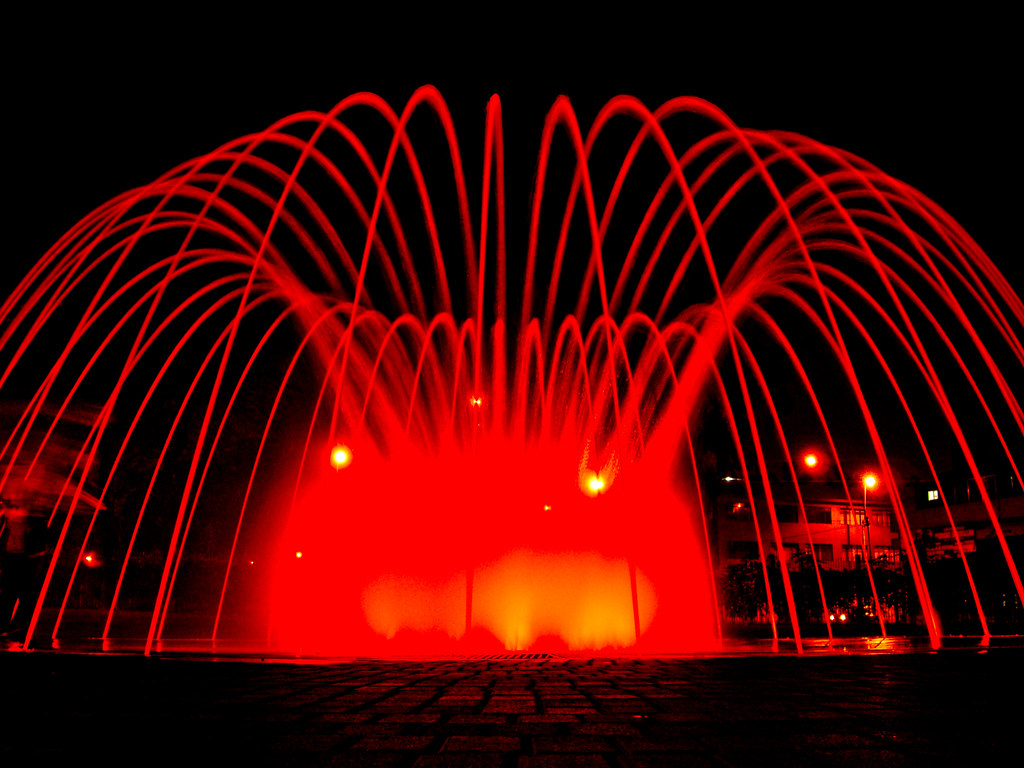
You would expect that, as an animated film, there would not be very much violence.  However, the film seems to satirize the violence with a near celebration of violence.  Rama and Sita are seen under the fountain arch of rakshasa blood.  During fight scenes, heads comically pop off and blood gushes everywhere.

Fountain of (Rakshasa) Blood
Image from Kristian Golding


I like how the film is broken into commentary, singing, story, and the modern-day story.  I think it breaks up each section well and keeps the entire story interesting.  The gives a different perspective on the story.  The comment that most stuck out to me was the question why Sita didn't leave with Hanuman.  It seems logical that Sita would accept rescue when she had a chance.  They also portrayed Ravana to be originally good but was slowly corrupted, while the PDE Ramayana only mentioned negative qualities of Ravana.

The side story of Nina and Dave is also an interesting addition to the story.  I assume their relationship will parallel Rama and Sita's relationship in some way, but I don't know where they are going with the story yet.  So far, it all seems like setup for some larger event.  Dave flew to India for a 6-month contract, leaving Nina behind.  When his contract is extended, Nina joins him in India for the next year.  We can already see some strain in their relationship, and Dave seems somewhat clueless to Nina's emotions.