Thursday, October 8, 2015

Week 7 Storytelling: Watto Loses Everything

Watto was from the planet Toydaria, and despite a difficult youth, he had managed to do well for himself.  Oringally, Watto had served as a soldier for the Ossiki Confederacy Army on his home planet.  After he returned home from war he expected to continue his father's business.  His father owned multiple businesses across the system, but the largest was a food producer known as Monsanta.  Monsanta farmed algae and fish for the Toydarians and had a near monopoly on the planet's food supply.  Instead, when Watto returned home, he discovered that his brother Datto was running the empire.  His father informed him that Watto would be given a small junk shop on the planet Tatooine.  Watto should have suspected as much.  His father had always favored his older brother.  He packed his things and took the next ship to Tatooine.

Watto would not let his father or brother stop him from acquiring fame and fortune.  He set about becoming the best junk dealer in the galaxy.  He began learning about trade from the local Jawas.  Before long, his junk shop was the most profitable on Tatooine.  Around this time he decided to join the slave trade.  He had an uncanny ability to choose the best slaves.  He even found a young boy by the name of Anakin who had a mechanical aptitude and boosted the productivity of his shop by nearly double.  Watto became very wealthy and very happy.  The business almost ran itself with Anakin there.

While everything was going well for Watto, Monsanta was going through a rough patch.  Datto was not nearly as competent as Watto.  In order to make himself feel better, Datto planned a trip to visit his brother.  Datto owned an empire while his brother had a measly junk shop.  However, to his surprise, when Datto arrived on Tatooine, he discovered that Watto was the wealthiest creature on the planet.  Datto grew jealous and hatred burned in his heart.  He decided that he would send his servant Shakuni to win everything from Watto in a gambling match.

If Watto had one weakness, it was gambling.  He loved to wager on the podraces.  Just before the biggest podrace of the year, two groups of foreigners came to Tatooine.  The first was Shakuni and his aides.  The second was Jedi Knight Qui-Gon Jinn, Padme Amidala, and a strange Gungan named Jar Jar Binks. Qui-Gon Jinn claimed to have a podracer that he won in a game of chance.  He wanted Anakin to pilot it for him.  If Anakin won, Watto would keep the prize money.  If Anakin lost, Watto would keep Qui-Gon's ship.  It was too good to turn down.  Similarly, Shakuni offered him a deal that was too good to be true.  Watto bet Shakuni that the Dug Sebulba would win the race.

If Sebulba won, Watto would have been the wealthiest man in the system.  But instead Anakin won the race, and Watto lost everything.  Watto spent the rest of his days destitute and alone.


Watto
Original Image


Author's Note:  I watched Star Wars Episode I last night.  Like Yudhisthira, Watto's weakness is gambling.  While Watto is extremely different from Yudhisthira, I thought he would make a good character to retell Yudhisthira's story.

Bibliography:
"Mahabharata" by Peter Brook. Website: YouTube.

Wednesday, October 7, 2015

Reading Diary B: Peter Brook's Mahabharata

The gambling match still baffles me.  I don't understand how Yudhisthira, one of the wisest men, could gamble everything away.  He had nothing to win and everything to lose.

The king Dhritarashtra is portrayed as a caring and normal man who is trying to do the best by his children.

Amba tries to get Bhima to kill Bhishma.

Arjuna's exile seems to be missing entirely from the film.  There is also no House of Fire.  Half the movie remains and the war is the only large event that remains.

The Kauravas try to kill the Pandavas in exile.  Vyasa interferes and puts a stop to the attack.

Bhima encounters Hidimba later chronologically.  He is married to Draupadi at this point.  Hidimbi looks overjoyed when her brother is killed.  It is somewhat disturbing that Hidimbi goes from being faithful to her brother to experiencing joy at his death only a few minutes later.  Kunti is not here for this fight.

The Kauravas use fire to invoke Arjuna.  They can see that he is searching for weapons and the Kauravas can even talk to him.  I wonder what type of god or magic makes this possible.

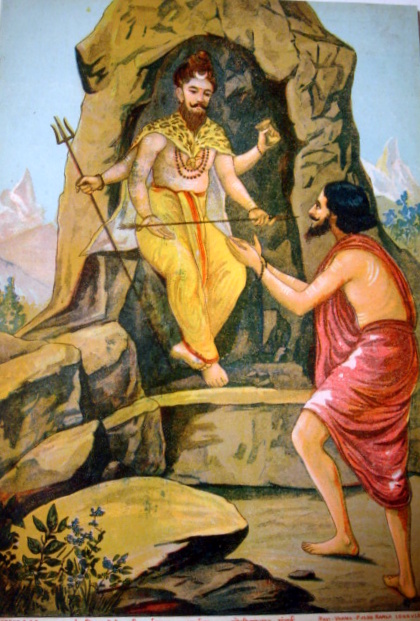
Arjuna gets a weapon from Shiva.

Karna cares for a Parashurama in the wilderness and asks for a weapon in return.  Parashurama gives Karna a formula that will call a creature from heaven to give him a weapon.  When Parashurama sleeps, a worm eats a hole in Karna's thigh.  Parashurama accuses Karna of lying to him about being a kshatriya and curses him to forget the formula.  Also, where did Karna's armor go?

The Riddles at the Lake makes a little more sense now.  The Pandavas are overcome by an overwhelming thirst that makes them drink even when their brothers are dead.

Arjuna gets the Pashupata from Shiva
Image from Wikipedia


Tuesday, October 6, 2015

Reading Diary A: Peter Brook's Mahabharata

Peter Brook's Mahabharata has several differences from the PDE Mahabharata.  Below I've listed the biggest differences that I noticed or things that stood out to me this time that I did not notice earlier.

I really like how they start with Vyasa as the story teller and constantly go back to him.

Vasu's sperm is given to a falcon; he doesn't ride a flying chariot.

The PDE Mahabharata focuses on Bhishma's "terrible oath" but the film sees his action more positively - "The gods applauded his actions."  He is portrayed as noble.

Amba goes back to Bhishma and threatens him after Bhishma refuses to marry her.

Pandu makes his brother king
I don't remember Kunti's mantra

I only remember 4 Pandavas instead of 5.  The PDE Mahabharata only discusses Arjuna, Bhima, and Yudhisthira in depth.

A ball of flesh comes out of Gandhari's womb.  This is a pretty memorable visual and explains how she can have so many children.

Ajuna's promise to fight Drona and fight to kill
Youth rejected because too many pupils

The film portrays Drona as cruel.  Ekalavya, the youth that cuts off his thumb for Drona is rejected because Drona already has enough pupils, not because he comes from a kingdom of robbers.

The film skips over a lot of material before the dice game.

Pandavas get bad land from Dhritarashtra and improve that land so that they have a wonderful palace and all the people are happy.

The Kauravas, especially Duryodhana are maddened by jealousy.  They seem to be noble when they accept Karna.  However, after this they are only trying to keep up with the Pandavas.

Yudhisthira loves gambling in the film.  In the PDE Mahabharata, he is just unable to refuse a challenge.

Swayamvara challenge was shown as the contest in Peter Brook's film
Image from Wikipedia

Wednesday, September 30, 2015

Week 6 Storytelling: Bhima Slays Kichaka

For the final year of their exile, the Pandavas and Draupadi disguised themselves and lived in the courts of King Virata.  Although Draupadi had assumed the guise of a maid known as Sairandhri, she could not hide her radiant beauty.  When Prince Kichaka, the brother of the Queen, first beheld her, he immediately fell in love.  Kichaka decided to win Sairandhri's heart, so he convinced his sister, the Queen, to assign Sairandhri to bring him his afternoon meal.  Every day for an entire fortnight, when Sairandhri brought the food, the prince asked her to be his bride.  And each day she said nothing.

Finally, Kichaka grew impatient.  If the fair maiden would not give him what he wanted, then he would take it by force.  The next day, when Sairandhri was delivering food, Kichaka grabbed her by the arm and began to tear at her clothes.  She punched him in the nose and ran from his chambers as fast as she could.  Immediately, she went to her husband Bhima and told him everything that had taken place.

"Avenge me Bhima!  Do not sit idly while Kichaka tries to violate my honor."

"Have no fear.  Tomorrow will be his last day on this earth."

The next afternoon, Sairandhri brought the Prince his food.  But instead of taking it to him, she left the tray by his door and knocked.  When Kichaka opened the door, he found his tray of food.  Underneath the cup of wine was a brief note that reeked of perfume.  "Meet me in the dancing hall."

Kichaka wasted no time on his way to the dancing hall.  He hoped that Sairandhri had finally come to her senses.  The room was dark when he arrived, but he entered without hesitation.  Bhima, who was hiding in the corner, leapt out and threw Kichaka to the ground.  Bhima grabbed Kichaka by the hair and the feet and wrapped him around his knee.  Kichaka's back crackled as it broke in every imaginable place.  Then, Bhima kneaded Kichaka's body until every feature was beyond recognition.  It was unclear whether the heap of meat was an animal or a man.  Calmly, Bhima placed the body into a sack and carried him to the kitchen.

That evening, the entire royal household feasted on steak.  King Virata praised the meal as "our chef's finest work."  Even Queen Sudeshna, who normally avoided eating meat, gobbled up her entire portion.  Because of the delicious dinner, no one save Bhima and Sairandhri noticed that Prince Kichaka was missing.  Out of all the royal party, Bhima enjoyed his meat the most.  He thought about his vow to slay Dushasana and drink his blood.  Bhima looked into his cup.  Its contents were red as wine but slightly thicker.  He took a long draught from his chalice and smiled.


Bhima kills Prince Kichaka
Image from Wikipedia


Author's Note:  Of all the Pandavas, Bhima seems to kill his enemies in the most brutal ways.  I wanted to tie his murder of Prince Kichaka with his vow to slay Dushasana and drink his blood.  Most of the story follows the original, but I added the last paragraph, where Bhima and the royals eat Prince Kichaka, to emphasize Bhima's brutality.

Bibliography:
"Bhima and Kichaka" by C.A. Kincaid from The Indian Heroes (1921). Web Source: PDE Mahabharata.

Monday, September 28, 2015

Reading Diary B: PDE Mahabharata

65. Death of Drona - At certain points in the battle, each side compromises their honor or moral code in some way to gain an advantage. This is the main case for the Pandavas. They don't strictly lie, but they kill Drona through deceit.  As Drona was almost like a father to the Pandavas, it is sad to see him go in such a manner.

66. Bhima and Duhshasana - This takes the cake for Bhima's most gruesome kill. He's pretty good at killing people in gruesome ways. He completes his vow by slaying and drinking the blood of Dihshasana.

72. The Pandavas and Bhishma - Bhishma's fable gives a lesson that many of the heroes in the Mahabharata need to understand. A seemly evil act might be justified in some circumstances. For instance, when Arjuna is banished for 12 years because he walks into the room where Yudhishthira sits next to Draupadi. It would make sense for him to not go into exile. Bhishma's moral also makes every decision much more theologically difficult. How is someone to know what is right or wrong?

80.  The Afterlife - Yudhishthira's journey to the nether regions reminds me of Dante's Inferno.  Yet, for him, it is only a test. The description of heaven raises a few questions about the afterlife.  When they attain heaven, is it their souls in new celestial bodies that dwell there?  Are the souls the same as they were for previous incarnations and do they remember all previous incarnations of themselves. For instance, Draupadi is there in heaven, but she was another in a previous life.  Krishna says (in a previous chapter) that everything that is has always been and will always be.  So does that mean that Draupadi has existed in many incarnations and is just now attaining heaven, where her soul will now dwell for eternity, now out of the pool of souls that make up life on Earth. That also raises a question about god's avatars. When they become incarnations on Earth, do they share the same soul as their celestial self?  When Krishna ascended to heaven, does he remain a separate entity from Vishnu, or does he rejoin with Vishnu to be one celestial being?

Yudhishthira's Journey to Hell

Reading Diary A: PDE Mahabharata

46. Bhima and Hanuman - Both Bhima and Hanuman are extremely physical and deadly in battle which makes sense because they both have the same father. The description of Bhima entertaining himself by killing lions, tigers, and elephant and then using their bodies to defeat other creatures makes Bhima seem incredibly cruel.  While I haven't counted, it seems like Bhima has the most kills. If not, he has some of the most gruesome kills.


48. Karna and Indra - This brings me back to when Karna and Arjuna first met. If only they could have humbled themselves and become allies, they would have rules the world. Now that Karna has lost his armor, he is surely doomed.

50. Riddles at the Lake - This reminds me of the Hobbit when Gollum and Bilbo Baggins exchange riddles. Considering the Pandava's wisdom and strength I'm surprised that they decided to drink after seeing their brethren dead before them.  Although it starts out poorly, Yudhishthira wins them the boon of going undetected in their last year of exile.

52. Bhima and Kichaka - This is probably Bhima's most gruesome slaughter. I can't imagine someone who is kneaded beyond recognition. I would not want to cross Bhima. 

60.  The Battle Begins - This is like a movie.  One of my favorite quotes is "Blood dropped like rain out of heaven."  Ghatotkacha, Arjuna's rakshasa son is very impressive.  He can grow to an enormous size.  I don't understand why Bhishma continues fighting even though he doesn't believe in the cause.

Ghatotkacha

Friday, September 25, 2015

Thoughts about Comments

For me, the attribute that makes a comment most useful or entertaining to read is specificity.  General impressions are nice, but I really appreciate when someone points out a particular aspect of my story that they liked or disliked.  For instance, on my Week 3 story, two people mentioned that they liked how I described Vali's morning workout.  This is helpful to me because I know that I did a good job in this instance of making the character relatable, which was the entire point of the story.

So far, I haven't received much in the way of criticism or suggestions.  While this inflates my ego, it doesn't make me a better writer.  I really would appreciate more constructive criticism.

I also appreciate comments on my image.  As the first impression of the story, I think the images are very important.  This is probably because I am a photographer, so I like to think about images, and I am happy when other people enjoy my photography.  Although I don't expect anyone here to give me constructive feedback on my photography, I've found that is something difficult to come by.

Additionally, on several of my posts, I've provided links within the story or author's note.  I appreciate when people who comment on those links so that I know they were somewhat useful.

I think the most interesting comments I receive on my introduction post are ones with facts, anecdotes or links.  Its almost always more fun to read a comment when you get an interesting fact or story out of it.
 
With my comments so far, I think I've done a good job of providing specific suggestions for people to improve their writing.  However, I need to focus on providing more specific praise.