Showing posts with label Week 11. Show all posts

Monday, November 9, 2015

Famous Last Words Week 11

Almost there
Image from Flickr


I finished most of my assignments early this week.  I was able to finish the blog comments and project feedback almost as soon as they were released.  The only items I finished at the last minute were a new Storybook post and the extra credit assignments.  Since I finished my last exam for the semester (other than one final) last Friday, I have had a lot more time to get homework done.    This has been particularly beneficial this week since I started applying for jobs.  Before this week, I have put off applying for a full-time position, but I was able to spend a good portion of time on Thursday, Friday, and Saturday working on my job search.  I finished updating my resume, and I applied at two different companies.  I am excited to graduate and move on to another challenge, but I need to figure out what that will be as soon as possible.

I also realized this week that I am very close to finishing the semester in Epics of India.  After this week, I will only have sixty points left until I reach the threshold for an A.  I can either get all the extra credit next week and get most of the way there, or I can just finish the next two weeks without any extra credit.  Either way I will finish the class shortly.  With the extra time, I'll be able to focus on finishing my other classes and applying for jobs.  Since I am an engineer, I usually have final exams in all my classes.  However, this semester I only have one final.  I should be able to entirely finish two of my classes before Thanksgiving and finish the semester relatively stress-free.  Now that I can see the light at the end of the tunnel, I will work a lot harder to finish as soon as possible.


Week 11 Review

Scripturient
Image from Announcements

Since this is National Novel Writing Month, I thought scripturient was a particularly apt word.  Writing a novel in a month would be a lot of fun, but I don't quite have the time this year.  This class has inspired me to write more than any other class I've taken.

Wednesday, November 4, 2015

Week 11 Storytelling: The Human King's Daughter

There was once a great king named Parikshit who ruled over the entirety of Lake Ayodhya.  He was outside for his afternoon hop when he saw the largest and most juicy fly that he had ever seen.  The chase begun.  For nearly three days, the great king chased his prey.  The fly landed, the king was in reach, and he was just about to snap up the fly.  Suddenly, another tongue grabbed the fly, and it was gone.  Parikshit's heart filled with rage.  Who dared interfere with his hunt?  He turned to face his enemy so that he might banish him from the kingdom.  But when he saw who had taken his fly, his heart stopped.  It was the most beautiful frog he had ever seen.  She had the most beautiful yellow eyes, her spots were perfectly round, and the way she caught flies with her tongue was exquisitely graceful.  He knew instantly that this frog must become his queen.  He approached her to ask for her tongue in marriage.

"Lovely lady, you are the most beautiful frog I have ever seen.  Marry me and be my queen."

"I will become your wife, but you must make me a promise."

"Anything you ask my dear."

"Never let me gaze upon pavement."

King Parikshit thought this was a strange request, but he readily agreed.  The next day they were married on a lilypad in Lake Ayodhya.  The couple lived very happily.  Every morning, they went on a hop around the lake. One morning, they stumbled upon a sidewalk.  Although the king had heard about concrete, he had never seen any for himself.

"Darling, come here and see this marvelous sidewalk."

His wife joined him on the sidewalk.  The king began to examine the pavement with great interest.  But when he turned around, his queen was gone.  Walking towards him was a human.  King Parikshit dashed off with a heavy heart.  He later realized that the human must have killed his bride.  He resolved to strike back.  Before any frog could have an audience with the king they were required to bring him possession of a human.  The King knew how much humans liked their possessions, and soon King Parikshit's castle was surrounded by watches, baby toys, and dollar bills.

After about a month the human king Ayusha decided that he had enough.  He disguised himself as a frog and sought an audience with the king.

"Oh great king, I am Ayusha, king of men.  My people have suffered enough.  Stop taking our goods, and let us have peace."

"A human killed my queen, and I must have retribution for her life."

"Your queen is still alive.  She is my daughter Sushavana.  She disguised herself as a frog when you met her.  She has deceived many frogs this way, and does not deserve to be queen."

King Parikshit was saddened that queen had left him, but he decided to forgive her if she came back.  Sushavana then reassumed her form as a frog and returned to Parikshit.  The couple lived the rest of their lives in peace and happiness by Lake Ayodhya.

The Frog Queen
Image from Wikipedia


Author's note: I really enjoyed the story about the Frog King's Daughter.  In the story, King Parikshit sees a beautiful woman and decides to marry her.  When the two go swimming, the Queen turns back into a frog.  Thinking that the frog's are responsible for his queen's death, he requires his citizens to slaughter all the frogs that they could find.  Eventually, the king finds out that his wife was a frog in the form of a woman.  He takes her back and they have three children together.  I decided to retell this story from the opposite perspective by making the main characters frogs instead of humans.

Bibliography: Kincaid.  Tales from the Epics.  Frog King's Daughter.

Tuesday, November 3, 2015

Reading Diary B: Tales from the Epics

Notes on Kincaid.  Tales from the Epics.

Ruru and Pramadvara.
Ruru gave Pramadvara half of his life to make her return from the dead after she was bitten by a snake.


The Frog King's Daughter.
This story, once again, contains love at first sight.
The king Parikshit falls in love with a beautiful princess who happened to be a frog.
I don't understand why the princess requires the king to forbid her from looking at water on the ground.  Does water automatically make her turn back into a frog?  This makes even less sense when the frog king comes to Parikshit's court and says that his daughter deceived Parikshit and many other men.
Frog's sons were cursed to hate sages.
Vamadeva, whose horses were stolen, is a very forgiving sage, especially in comparison to the other sages we have heard stories about.


The Descent of the Ganges.
Queen Sumati gave birth to a gourd that contained 60,000 sons.
Prince Asamanja, the son of King Sagar, was banished from the kingdom and never heard from again.
In order to punish King Sagar for pride of his sons, Vishnu came, disguised as an old woman and stole the sacrificial horse from them.
The 60,000 sons set out to find the horse.  They dug through the earth to get to the other side and asked elephants which hold up the earth if they had seen the horse.  Finally, they found a meadow where the horse and the old woman were.
The old woman turned into a god and fire shot out of its eyes to consume the 60,000 sons.  This must have been a very impressive sight.

The Tale of the Pole Star.
Dhruv walks along a path to find Vishnu and becomes the pole star.

60,000 sons could fill OSU's Boone Pickens Stadium
(OU's stadium capacity is 82,000)
Image from Flickr

Monday, November 2, 2015

Reading Diary A: Tales from the Epics

Notes on Kincaid.  Tales from the Epics.

The tortoise who holds up the mountain on his back is referred to as the "Tortoise king;" there is no mention of Kurma, the avatar of Vishnu.

Vishnu gives the ambrosia to only the Devas because the demons tried to take it for themselves.  In other stories, the gods do not want to share the nectar with the demons.

The eclipse of the sun is caused by the Asura Rahu, who lost his head when he tried to drink the nectar.

Uttanka cursed the king for giving him unclean food.  Who curses someone to blindness because their food is cold and has a hair in it?  Is seems very outrageous to me that Uttanka, who just received the Queen's earrings for free, would curse the king.

The Indian year has 6 seasons

King Kashyapa's wife, Queen Kadru, wants to be mother of 1000 snakes.  When her sons refuse to do her bidding, she curses them to be consumed in a snake sacrifice.  What mother curses her own children?  It seems like the characters in these tales curse each other so freely.  What is particularly interesting to me is their ability to make some of these curses.  How can they just say that another person will be blind or not have any children and then it happens?

King Kashyapa's other wife, Vinata, has two sons.  The first curses her to slavery for breaking his egg, and the second son is a bird.  How does a naga have a bird for a son?

After Indra steals back the ambrosia, the snakes but their tongues on the sharp grass, which is why snakes now have split tongues.

In addition to curses, the characters of these Indian stories also seem to make strange promises.  Jaratkaru promises only to marry someone with his same name that will cost him nothing.  This requirement seems so arbitrary and unnecessary.

When Jarakaru finally gets a wife, he curses her for waking him up so he can say a prayer.  Once again, this seems very backwards.  His wife was only trying to help him and he punishes her for this.

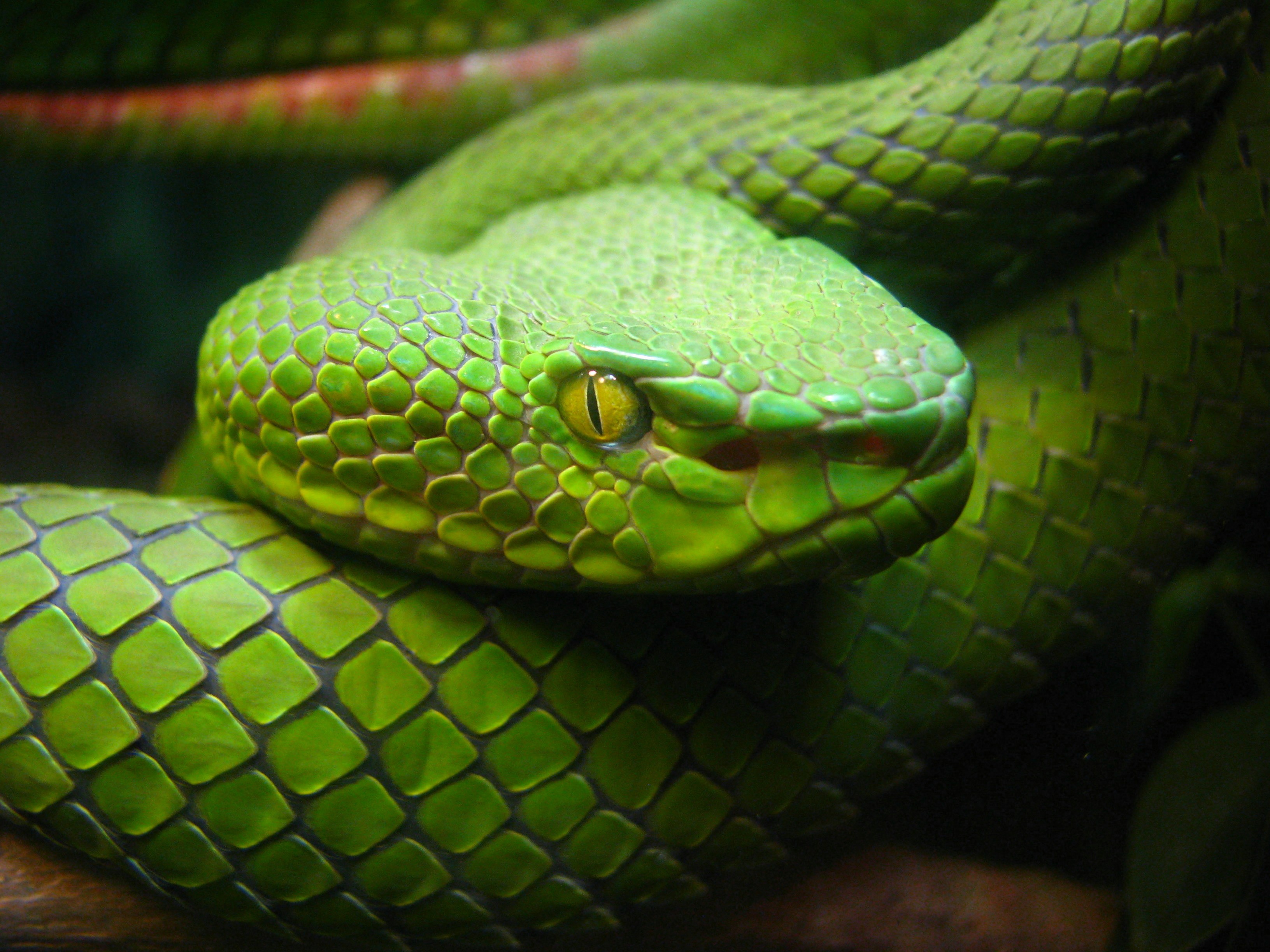
One of One Thousand Snakes
Image by Carolyn