Wednesday, September 30, 2015

Week 6 Storytelling: Bhima Slays Kichaka

For the final year of their exile, the Pandavas and Draupadi disguised themselves and lived in the courts of King Virata.  Although Draupadi had assumed the guise of a maid known as Sairandhri, she could not hide her radiant beauty.  When Prince Kichaka, the brother of the Queen, first beheld her, he immediately fell in love.  Kichaka decided to win Sairandhri's heart, so he convinced his sister, the Queen, to assign Sairandhri to bring him his afternoon meal.  Every day for an entire fortnight, when Sairandhri brought the food, the prince asked her to be his bride.  And each day she said nothing.

Finally, Kichaka grew impatient.  If the fair maiden would not give him what he wanted, then he would take it by force.  The next day, when Sairandhri was delivering food, Kichaka grabbed her by the arm and began to tear at her clothes.  She punched him in the nose and ran from his chambers as fast as she could.  Immediately, she went to her husband Bhima and told him everything that had taken place.

"Avenge me Bhima!  Do not sit idly while Kichaka tries to violate my honor."

"Have no fear.  Tomorrow will be his last day on this earth."

The next afternoon, Sairandhri brought the Prince his food.  But instead of taking it to him, she left the tray by his door and knocked.  When Kichaka opened the door, he found his tray of food.  Underneath the cup of wine was a brief note that reeked of perfume.  "Meet me in the dancing hall."

Kichaka wasted no time on his way to the dancing hall.  He hoped that Sairandhri had finally come to her senses.  The room was dark when he arrived, but he entered without hesitation.  Bhima, who was hiding in the corner, leapt out and threw Kichaka to the ground.  Bhima grabbed Kichaka by the hair and the feet and wrapped him around his knee.  Kichaka's back crackled as it broke in every imaginable place.  Then, Bhima kneaded Kichaka's body until every feature was beyond recognition.  It was unclear whether the heap of meat was an animal or a man.  Calmly, Bhima placed the body into a sack and carried him to the kitchen.

That evening, the entire royal household feasted on steak.  King Virata praised the meal as "our chef's finest work."  Even Queen Sudeshna, who normally avoided eating meat, gobbled up her entire portion.  Because of the delicious dinner, no one save Bhima and Sairandhri noticed that Prince Kichaka was missing.  Out of all the royal party, Bhima enjoyed his meat the most.  He thought about his vow to slay Dushasana and drink his blood.  Bhima looked into his cup.  Its contents were red as wine but slightly thicker.  He took a long draught from his chalice and smiled.


Bhima kills Prince Kichaka
Image from Wikipedia


Author's Note:  Of all the Pandavas, Bhima seems to kill his enemies in the most brutal ways.  I wanted to tie his murder of Prince Kichaka with his vow to slay Dushasana and drink his blood.  Most of the story follows the original, but I added the last paragraph, where Bhima and the royals eat Prince Kichaka, to emphasize Bhima's brutality.

Bibliography:
"Bhima and Kichaka" by C.A. Kincaid from The Indian Heroes (1921). Web Source: PDE Mahabharata.

Monday, September 28, 2015

Reading Diary B: PDE Mahabharata

65. Death of Drona - At certain points in the battle, each side compromises their honor or moral code in some way to gain an advantage. This is the main case for the Pandavas. They don't strictly lie, but they kill Drona through deceit.  As Drona was almost like a father to the Pandavas, it is sad to see him go in such a manner.

66. Bhima and Duhshasana - This takes the cake for Bhima's most gruesome kill. He's pretty good at killing people in gruesome ways. He completes his vow by slaying and drinking the blood of Dihshasana.

72. The Pandavas and Bhishma - Bhishma's fable gives a lesson that many of the heroes in the Mahabharata need to understand. A seemly evil act might be justified in some circumstances. For instance, when Arjuna is banished for 12 years because he walks into the room where Yudhishthira sits next to Draupadi. It would make sense for him to not go into exile. Bhishma's moral also makes every decision much more theologically difficult. How is someone to know what is right or wrong?

80.  The Afterlife - Yudhishthira's journey to the nether regions reminds me of Dante's Inferno.  Yet, for him, it is only a test. The description of heaven raises a few questions about the afterlife.  When they attain heaven, is it their souls in new celestial bodies that dwell there?  Are the souls the same as they were for previous incarnations and do they remember all previous incarnations of themselves. For instance, Draupadi is there in heaven, but she was another in a previous life.  Krishna says (in a previous chapter) that everything that is has always been and will always be.  So does that mean that Draupadi has existed in many incarnations and is just now attaining heaven, where her soul will now dwell for eternity, now out of the pool of souls that make up life on Earth. That also raises a question about god's avatars. When they become incarnations on Earth, do they share the same soul as their celestial self?  When Krishna ascended to heaven, does he remain a separate entity from Vishnu, or does he rejoin with Vishnu to be one celestial being?

Yudhishthira's Journey to Hell

Reading Diary A: PDE Mahabharata

46. Bhima and Hanuman - Both Bhima and Hanuman are extremely physical and deadly in battle which makes sense because they both have the same father. The description of Bhima entertaining himself by killing lions, tigers, and elephant and then using their bodies to defeat other creatures makes Bhima seem incredibly cruel.  While I haven't counted, it seems like Bhima has the most kills. If not, he has some of the most gruesome kills.


48. Karna and Indra - This brings me back to when Karna and Arjuna first met. If only they could have humbled themselves and become allies, they would have rules the world. Now that Karna has lost his armor, he is surely doomed.

50. Riddles at the Lake - This reminds me of the Hobbit when Gollum and Bilbo Baggins exchange riddles. Considering the Pandava's wisdom and strength I'm surprised that they decided to drink after seeing their brethren dead before them.  Although it starts out poorly, Yudhishthira wins them the boon of going undetected in their last year of exile.

52. Bhima and Kichaka - This is probably Bhima's most gruesome slaughter. I can't imagine someone who is kneaded beyond recognition. I would not want to cross Bhima. 

60.  The Battle Begins - This is like a movie.  One of my favorite quotes is "Blood dropped like rain out of heaven."  Ghatotkacha, Arjuna's rakshasa son is very impressive.  He can grow to an enormous size.  I don't understand why Bhishma continues fighting even though he doesn't believe in the cause.

Ghatotkacha

Friday, September 25, 2015

Thoughts about Comments

For me, the attribute that makes a comment most useful or entertaining to read is specificity.  General impressions are nice, but I really appreciate when someone points out a particular aspect of my story that they liked or disliked.  For instance, on my Week 3 story, two people mentioned that they liked how I described Vali's morning workout.  This is helpful to me because I know that I did a good job in this instance of making the character relatable, which was the entire point of the story.

So far, I haven't received much in the way of criticism or suggestions.  While this inflates my ego, it doesn't make me a better writer.  I really would appreciate more constructive criticism.

I also appreciate comments on my image.  As the first impression of the story, I think the images are very important.  This is probably because I am a photographer, so I like to think about images, and I am happy when other people enjoy my photography.  Although I don't expect anyone here to give me constructive feedback on my photography, I've found that is something difficult to come by.

Additionally, on several of my posts, I've provided links within the story or author's note.  I appreciate when people who comment on those links so that I know they were somewhat useful.

I think the most interesting comments I receive on my introduction post are ones with facts, anecdotes or links.  Its almost always more fun to read a comment when you get an interesting fact or story out of it.
 
With my comments so far, I think I've done a good job of providing specific suggestions for people to improve their writing.  However, I need to focus on providing more specific praise.

Wednesday, September 23, 2015

Week 5 Storytelling: Palace of Fire

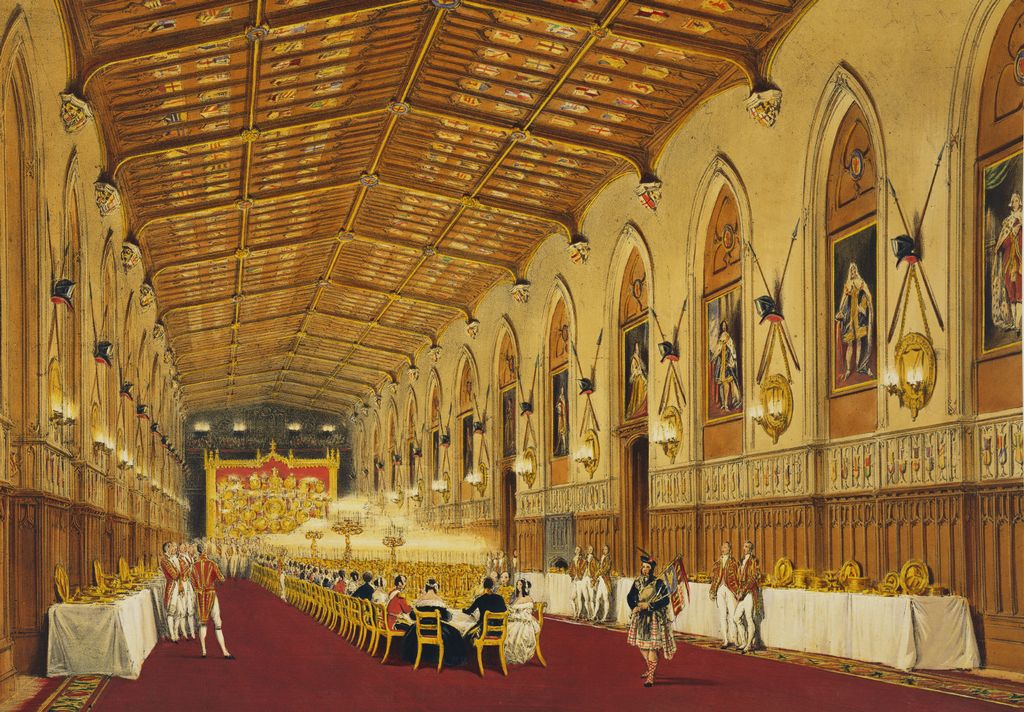
The Pandavas and their mother, Queen Kunti rode to the top of the hill, where an enormous palace stood, its magnificence matched nowhere else on Earth. It was a malevolent masterpiece of Prince Duryodhana, but the Pandavas did not yet realize the Prince's cruel intent.  They entered the Great Hall.  Above them was a vaulted wooden ceiling.  Emblems of all the great families lined the ceiling, and statues of fierce warriors watched over the vast space.  Despite their royalty and wealth, the Pandavas had never gazed upon any palace as grand.  They looked forward to spending the next few months in the place.

The Great Hall (in a strange gothic style)
Image from Wikipedia


Now Yudhishthira had received a warning from Prince Vidura about Duryodhana's treachery.  He soon realized that the entire palace was built with wood and soaked in oil.  His rage was immediately inflamed and he desired to leave the castle at once and kill Purochana, the guard Duryodhana had sent along with them.  Yudhishthira realized that Purochana had been sent to set the palace ablaze.  However, he realized that killing Purochana would seem unjustified and anger his people.  Instead, as he calmed down, he concocted a different plan to enact his revenge.  He counseled with his mother and the rest of his brothers, and they set to work at once.

The next day they announced their plans to hold a grand banquet to celebrate the completion of the palace.  As a reward for overseeing its completion, the Pandavas invited Purochana and all the other guards to attend this feast.  Yudhishthira went into the city hire additional kitchen staff and make the necessary arrangements.  Unbeknownst to Purochana, he also found a miner to help him complete a special project.  For the next fortnight, the Pandavas kept Purochana under a keen eye to make sure he did not set the palace on fire.

Finally, the day of the feast arrived.  The tables were decorated to their finest and there was enough food to feed an entire army.  Near the end of the meal, Yudhishthira accidentally knocked over a candle while raising his glass.  The table immediately burst into flame.  At the same time, all around the palace, servants set fire to the building and left with great haste.  The Great Hall stirred with commotion as the guards rushed to leave.  In their hurry, none of them realized that the royal family had disappeared.  The entire palace was engulfed in flames and the guards had no means of escape.  They all perished.

The next morning, the townspeople saw the heap of ashes and began to mourn the loss of the royalty.  At that time, the Pandavas arose from the underground shelter which the miner had built.  When the people saw the Pandavas arise from the ashes they shouted, "Masters of the Flames!"  Thus the Pandavas had their revenge and their glory was doubled throughout their kingdom.

Author's Note:  This story was particularly difficult to write.  I enjoyed the story about the "House of Fire" especially because of the tunnel.  However, building a tunnel seemed somewhat pointless since the Pandavas could have just walked out of the house.  I wanted to retell the story where the Pandavas are in the house when it catches fire so an underground passage is needed.

Bibliography:
"The House of Fire" by C.A, Kincaid, from The Indian Heroes (1921).  Web Source: PDE Mahabharata.

Tuesday, September 22, 2015

Reading Diary B: PDE Mahabharata

21. House of Fire - I don't understand why Prince Vidura has a miner dig a tunnel out of the house.  Although it is an interesting way for them to escape, it seems unnecessary.  They weren't prisoners, they could have just left when they realized that the house was soaked in oil.  I also expected Vidura to be punished for the deaths of the innocent beggars, but instead, they just provided a means of escape for the Pandavas.

Vidura's Tunnel
Image from Wikipedia

23. Bhima and Hidimbi - That was fast.  Bhima barely knows Hidimbi when he decides to take her as his bride.  Bhima is very good at breaking backs.  He also breaks Jarasandha's back later in the story.

27. Wife of the Five Pandavas - It is strange to me that Draupadi is accidentally married to five men.  People in the Mahabharata take their words very seriously even when the outcome does not make sense.  For instance, when Arjuna walks in on Draupadi and Yudhishthira he stays true to his vow and goes into exile for 12 years.  Even though Yudhishthira did not want Arjuna to depart, he still leaves.  It seems like this attitude of taking the spoken word so seriously causes a lot of unnecessary trouble.

34. The Burning of the Forest - During the wedding of the Pandavas and Draupadi, the Pandavas are said to be an incarnations of Indra. It seems strange that Arjuna would fight Indra if he himself was an incarnation of Indra.

37. The Gambling Match - It is particularly sad to see Yudhishthira gamble all his possessions away.   Gambling is a dangerous endeavor.  Even today, many people are destroyed through their gambling addiction.  Since he lost every single match, I am surprised that Yudhishthira was not wise enough to know that the game was unfair.

Monday, September 21, 2015

Reading Diary A: PDE Mahabharata

4. Devavrata's Vow - What I don't understand is why Devavrata didn't marry Satyavati instead of vowing not to have children or take the throne.  It seems like it would have worked better for everyone if the two married.  That way, Devavrata would have still become king and the line would be continued.

5. Bishma at the Swayamvara - Bishma demonstrates his mighty power by capturing the three princesses.  His skill also makes me wonder why he took the vow; he could easily have been a powerful ruler.  It seems like Bishma tries to do right, but instead just makes more trouble for himself.  First vows not to be king, and now he captures the princesses.  Because of the trouble with Amba, Bishma will be slain by her.

Bishma abducts the three princesses


9. Pandu and His Wives - It seems like ancient kings really need to be more careful when they go hunting.  It is really a bummer for Pandu that he is doomed to die in the arms of one of his wives just for the small mistake that he made.  It seems that in many stories, the main troubles are caused by small mistakes.

18. The Arrival of Karna - It seems like Arjuna and Karna could have resolved their differences to their benefit if they had not been overly prideful and refused to back down.  I wonder how it would have changed their reactions if they knew that they were brothers.

19. Drona's Revenge -  I wonder if Drona will later regret taking out revenge on Drupada.  While Drona is happy with the settled score, it seems like Drupada wants to get revenge of his own.